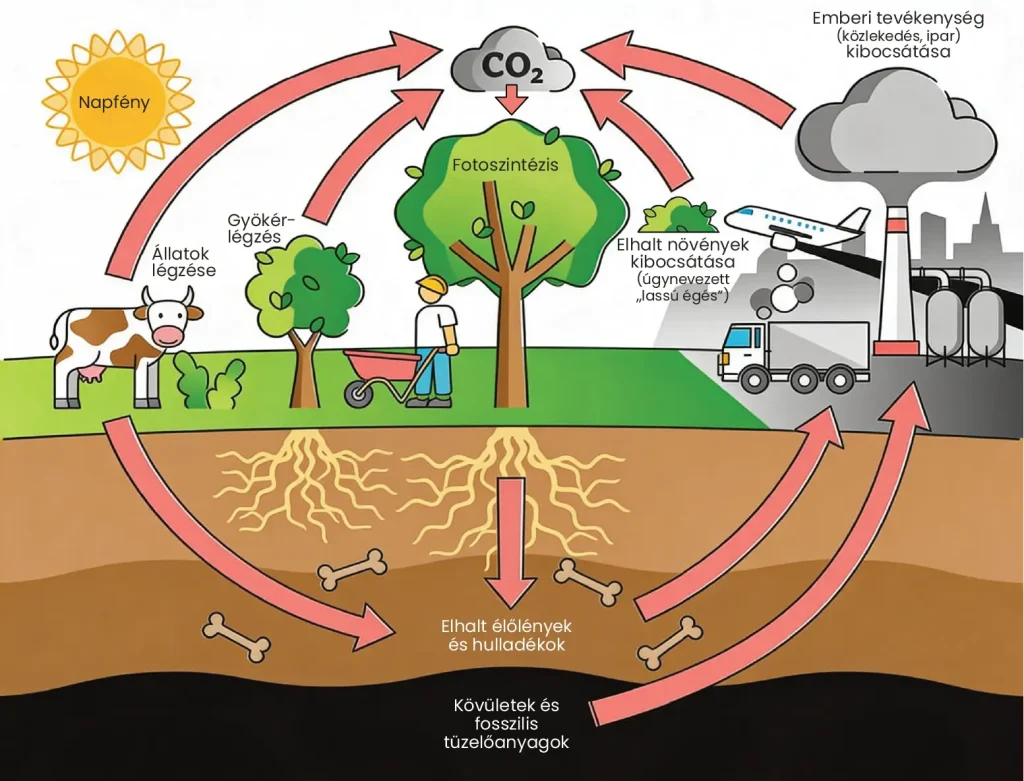
Humans and animals (and plants in the absence of light) are “alive” by the oxygen in the air. We breathe it into our lungs and then our bloodstream „carries” it to every cell in our body. Chemical reactions in the cells cause the oxygen to react with the hydrocarbons (e.g. sugars, fats) in the cells and convert them into carbon dioxide, releasing energy.
Machinery (e.g. cars, planes, tractors) and factories that use petrol and diesel also emit significant amounts of carbon dioxide.
Carbon dioxide is a „food” for green plants: during photosynthesis, they incorporate carbon into their own bodies and return oxygen to the air. Thus the cycle continues over and over again.
When the balance is upset
The problem starts when more carbon dioxide is released into the air than plants can absorb. Carbon dioxide is a greenhouse gas that traps heat in the Earth's atmosphere.
It's like a foil tent: it lets heat in, but it doesn't let it out. The atmosphere around the Earth is normally in balance, but too much carbon dioxide „thickens” the heat-retaining layer.
As a result, the Earth's atmosphere is gradually warming as a key sign of climate change.
It is therefore important to understand and, where possible, measure the greenhouse impact of our own activities. Carbon dioxide (CO₂) is the main greenhouse gas emitted in our daily lives.
By coming to us, your trip also has a carbon footprint. You can calculate this by answering two simple questions:
Total distance travelled:0 km
CO2 emissions:0 kg
Wood equivalence:0 wood
ARE YOU READY FOR THE EXPERIENCE?
You don't need to look any further. Choose how you arrive - for a day or for longer.
Book a bed
Accommodation and experience in one - conveniently, all in one place.